Master’s in Artificial Intelligence Program Overview
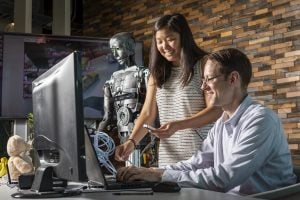
With the expertise of the Johns Hopkins Applied Physics Lab, we’ve developed one of the nation’s first online artificial intelligence master’s programs to prepare engineers like you to take full advantage of opportunities in this field. The highly advanced curriculum is designed to deeply explore AI areas, including computer robotics, natural language processing, image processing, and more.
We have assembled a team of top-level researchers, scientists, and engineers to guide you through our rigorous online academic courses. Because we are a hub and frontrunner in artificial intelligence, we can tailor our artificial intelligence online master’s content to include the most up-to-date practices and offer core courses that address the AI-driven technologies, techniques, and issues that power our modern world.

The online master’s in Artificial Intelligence program balances theoretical concepts with the practical knowledge you can apply to real-world systems and processes. Courses deeply explore areas of AI, including robotics, natural language processing, image processing, and more—fully online.
At the program’s completion, you will:
- Be able to describe the requirements, drivers, functions, components, interdependencies, risks, and quality factors for various systems and processes.
- Possess the advanced skills needed to develop new artificial intelligence features.
- Select courses to tailor your degree and gain the knowledge that works best for you.
Our students are also innovative problem-solvers. Take a look at some of the research projects and presentations completed by our graduate computer science students.

Fall 2027: Full-Time Residential AI Master's in Washington, DC
Built for engineers ready to build artificial intelligence expertise in the heart of the city where policy, business, academics, and technology take shape on a global scale.
Programs
We offer two program options for Artificial Intelligence; you can earn a Master of Science in Artificial Intelligence or a graduate certificate.
Artificial Intelligence Courses
Get details about course requirements, prerequisites, and electives offered within the program. All courses are taught by subject-matter experts who are executing the technologies and techniques they teach. For exact dates, times, locations, fees, and instructors, please refer to the course schedule published each term.
Proficiency Exams
A proficiency exam is available in Artificial Intelligence. If you have not completed the necessary prerequisite(s) in a formal college-level course but have extensive experience in these areas, may apply to take a proficiency exam provided by the Engineering for Professionals program. Successful completion of the exam(s) allows you to opt-out of certain prerequisites.
Program Contacts
-
Email:bart.paulhamus@jhuapl.edu
-
Tony Johnson
Program Manager Artificial Intelligence, Program Manager Computer Science, Program Manager Cybersecurity, Program Manager Data Analytics Engineering, Program Manager Data Science, Program Manager Information Systems Engineering, Program Manager Robotics and Autonomous Systems Email:ajohn260@jhu.edu
-
Ian McCulloh
Assistant Program Manager Artificial Intelligence, Assistant Program Manager Computer Science, Assistant Program Manager Cybersecurity, Assistant Program Manager Data Science, Assistant Program Manager Information Systems Engineering, Assistant Program Manager Robotics and Autonomous Systems Email:imccull4@jhu.edu
-
Erhan Guven
Assistant Program Manager Artificial Intelligence, Assistant Program Manager Computer Science, Assistant Program Manager Cybersecurity, Assistant Program Manager Data Science, Assistant Program Manager Information Systems Engineering, Assistant Program Manager Robotics and Autonomous Systems Email:eguven2@jhu.edu
-
Email:meghan.stewart@jhu.edu
-
Email:Valeria.Alfaro@jhuapl.edu
Tuition and Fees
Did you know that 78% of our enrolled students’ tuition is covered by employer contribution programs? Find out more about the cost of tuition for prerequisite and program courses and the Dean’s Fellowship.
Why Hopkins?
When ambition meets opportunity, anything is possible. Earn your degree on your terms at Johns Hopkins Engineering for Professionals.

Network and Connect - Your knowledge is stronger with a network. In the applied and computational mathematics program, you will make career-advancing connections with accomplished scientists and engineers who represent a variety of disciplines across many industries.
Engineers See the World Differently - Watch our video to revisit the inspiration that sparked your curiosity in science and engineering.

Beyond Rankings: We help you fulfill your vision. - We are proud to be ranked among the top online graduate engineering schools by U.S. News & World Report. But we’re about more than just numbers and rankings—we’re focused on making sure you flourish as a learner and engineer.
Academic Calendar
Find out when registration opens, classes start, transcript deadlines and more. Applications are accepted year-round, so you can apply any time.
-

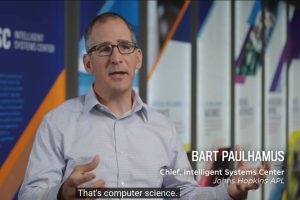
Video celebrates the National Academy of Engineering's commemoration of America's 250th anniversary
-

EP's Artificial Intelligence master's program is now in our nation's capital.
-

EP's Leslie Hamilton part of Microcapsule AI-driven Testing, Learning, and Accelerated Synthesis (ATLAS) project
Artificial Intelligence Master's FAQ
A: JHU EP’s Artificial Intelligence program balances theoretical concepts with practical knowledge, opening up a wide range of career opportunities for our graduates. Our alumni have gone on to careers in healthcare, robotics, cybersecurity, and more. Throughout your educational journey with us, you’ll receive full access to our world-class career guidance resources.
A: Master’s degrees open up a wider range of career opportunities than bachelor’s degrees do. This is because you’ll get hands-on training and experience in specialized, in-demand areas of AI. You’ll also have many opportunities to meet and network with industry professionals. Those with master’s degrees typically earn more per year than their bachelor’s degree counterparts.
A: If your prior education does not include the prerequisite courses, you may still be admitted under provisional status, followed by full admission once you have completed the missing courses. Missing courses may be completed with Johns Hopkins Engineering (all provisional courses are available) or at another regionally accredited institution.
A: Our artificial intelligence certificate program is designed for students who already have a master’s degree and are looking for further expertise.
A Master’s in Artificial Intelligence (AI) in the USA typically leads to high-paying roles, with average annual salaries often ranging between $125,000 and $150,000 for experienced professionals at higher levels, while early-career roles often start between %90,000 and $110,000
Source: Research.com
Artificial Intelligence Master’s Student Outcomes
Whether you pursue an online artificial intelligence master’s or a traditional format, the outcomes are designed to support both career advancement and career transition. With the in-demand knowledge and skills acquired during your program, you can position yourself for long-term growth in artificial intelligence careers.
Our AI master’s program equips you with a combination of technical and analytical knowledge and skills that are essential for success in this rapidly evolving field. You can expect to build proficiency in areas such as machine learning, natural language processing, computer vision, and data modeling. These competencies are supported by a strong foundation in programming languages like Python and frameworks commonly used in artificial intelligence development.
Outstanding problem-solving and critical thinking skills are required when working with artificial intelligence systems, which address complex, unstructured problems. You’ll design, test, and refine models, while also developing data management skills such as data cleaning and feature engineering. The effectiveness of AI systems depends on the quality of the underlying data.
Many master’s programs now emphasize ethical considerations and responsible AI practices. As global organizations adopt AI technologies, professionals must understand how bias, transparency, and accountability work together. These skills will lead to technical success and help maintain trust and compliance in professional settings.
Graduates of our artificial intelligence master’s program often pursue a variety of specialized and high-demand roles.
Common career paths include:
- AI engineer
- Machine learning engineer
- Data scientist
- Research scientist
- Software developer with a focus on AI integration
- Business intelligence analyst
- Data engineer
Many of these positions involve designing algorithms, building predictive models, and deploying AI-driven applications across different platforms. Others leverage artificial intelligence skills to improve organizational efficiency, automate processes, and generate insights from complex datasets.
According to the U.S. Bureau of Labor Statistics, employment in computer and information research science roles is projected to grow by 20% by 2034, much faster than the average for other fields. Such rapid growth highlights the value of completing an online artificial intelligence master’s, particularly for professionals seeking to move into more technical or specialized positions.
Artificial intelligence careers offer flexibility and diverse opportunities depending on your interests and professional background. Graduates commonly work in technology and software development, where AI is key to product innovation and service delivery. Professionals in this sector often contribute to advancements in automation, cloud computing, and intelligent systems.
Healthcare is another major industry for AI master’s graduates. Artificial intelligence is increasingly used to support diagnostics, personalize treatment plans, and optimize hospital operations. Your knowledge and skills in machine learning and data analysis can help improve patient outcomes and operational efficiency.
Financial services use artificial intelligence for fraud detection, risk assessment, and algorithmic trading, making data analysis and predictive modeling necessary skills. AI also helps in manufacturing with predictive maintenance and supply chain optimization, as well as in government for policy analysis and resource allocation.
Pursuing a master’s degree in artificial intelligence not only gives you technical expertise but also access to professional networks, faculty mentorship, and collaborative learning environments. These connections can facilitate your career growth, whether you wish to advance in your current field or transition into a new role focused on artificial intelligence.